FIND YOUR LOCAL
ARROW SERVICE CENTER
Myotis lucifugus
The only mammal capable of real flight, bats use both their legs and wings to fly.
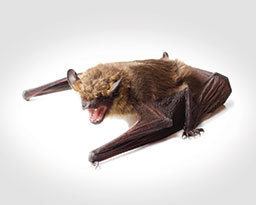
| Color | Brownish |
| Legs | 4 |
| Shape | Small mammal with glossy fur |
| Size | 3.5" with a wingspan of 10 inches, weighing 1/4 oz. |
| Antennae | False |
Similar to human radar technology, bats use echolocation to fly and gather their food, which consists primarily of insects. With an average lifespan of 25 to 40 years, bats typically have one baby per year, usually in the late spring or summer.
Forming maternal colonies inside buildings and caves, a single bat colony can range from 40 to 20,000 bats, so the damage done to structures can be quite extensive. When a cave becomes overpopulated, bat populations will turn to household attics that resemble caves when rearing their pups. Most active at dawn and dusk, bats vacate their nests and feed on insects during the night, returning to their caves at sunrise.
While bats can enter homes through gaps as small at 3/8 of an inch, common entry points include broken windows and gaps near vents. Since it is illegal to poison or harm bats, it’s vital to secure your home against a bat invasion.
Little brown bats feed at night and primarily eat airborne insects such as mosquitoes, midges, mayflies, and gnats. Many of the insects eaten by little brown bats are aquatic insects, and their predation helps prevent overpopulation of these pests.
Little brown bats mate once a year in the fall. The females delay ovulation for about seven months before they become pregnant in spring. Pregnancy lasts 50 to 60 days, and pups are born in late June or July. Females give birth to only one pup each year.
Little brown bats typically live between six to seven years, although have been known to live for ten years or longer. They begin to fly and feed on their own one month after birth, and will begin breeding at seven months.
Typically, bats do not attack humans. These little mosquito hunters are equipped with an echolocation system that allows them to fly through the darkness at top speeds. So while it may appear that they are swooping at your head, in all likelihood they are hunting an insect right above you.
However, while they may not attack humans, these critters do pose some health risks and should be avoided. Although less than one-half of 1 percent of all bats carry rabies, just like any other mammal, bats are capable of catching the disease. In addition to rabies, bats also carry histoplasmosis, a disease contracted by humans when dust from bat droppings is inhaled into the lungs.
Bat hair and bat guano can trigger allergies, and bats living in your attic can also carry fleas, ticks, and mites. Bat guano has also been known to corrode wood and drywall and become a source for mold growth.
Far from flying mice, bats aren’t actually rodents at all. Instead, they make up their very own group known as Chiroptera, which means hand-wing. And contrary to the phrase “blind as a bat,” most bats are not blind and many can see just as well as humans.
Though many see bats as dirty and ugly, most of these little flyers have cute faces and soft and silky fur. Of the more than 1,100 species of bat, only three species are known to be vampires, and none feed on humans. Most bat species feed on insects, fruit, nectar, and pollen. Pollinating our crops and protecting our health, bats eat billions of tons of insects every summer, and up to 1,000 mosquitos a night.
Signs of a bat infestation include bat activity around your home at dawn and dusk, pungent piles of bat guano, and hearing bats, especially if the colony is large.
Performed during late fall, exclusion methods undertaken after bats have left structures in the winter can be quite effective. To prevent bats from taking over your attic, use Mylar flash tape to prevent roosting in carports and chimneys. Mothballs, screens, bright lights and ultrasonic sound machines are also effective in deterring bats.
Since bats feed on insects, poison is not likely to be a strong deterrent. In fact, in most states it is illegal to poison bats because of the valuable role they play in the ecosystem.
There are several humane ways to get rid of brown bats. An important first step to keep them out of your attic, garage and home is to seal off any holes using boards, caulk, and screening materials. Be sure to wear protective gear, including goggles and a respiratory mask, if necessary. If the bats have already made their home in yours, you can install a bat cone, which is essentially a one-way exit for bats to get out.
Use the power of scent to deter bats by using scents like cinnamon, peppermint, or eucalyptus regularly. Cleaning the area the bats previously used to live in with an enzyme cleaner or other chemical cleaners is also effective in getting rid of brown bats.
Installing bright lights throughout your backyard and other outdoor spaces brown bats frequent can help deter them, as their nocturnal eyes don't enjoy it.
If you need to get rid of a bat colony currently roosting in your home, it is best to consult a wildlife removal expert who can utilize one-way bat doors and traps to gradually remove your bat population. Contact Arrow Exterminators for help treating your bat infestation today. Our experienced team of professionals is ready and waiting to help.
After you submit the information below, a trained professional in your area will get in touch within 1-2 business days to set up a date & time that is convenient for you.







 YouTube
 Facebook
 Twitter
 Instagram
 LinkedIn